
What keeps a house livable when the power goes out in a heatwave?
When the power drops out on a hot Hunter afternoon, the air-con, the fans and the fridge all stop at once. What keeps working is whatever you closed against the sun that morning.
That isn't just a shutter business talking up window coverings. Put seven official pages on heat side by side and the same instruction runs through all of them. Five are from the NSW Government, one is from Ausgrid, the network that supplies the Hunter, and one is from the Australian Government's Your Home guide. All seven tell you to keep the sun off your windows in the daytime.
Seven official pages on heat
| Publisher | Page | What it says about windows by day |
|---|---|---|
| NSW Government | Power outages | "close windows, blinds and curtains during the day" |
| NSW Government | Prepare your household | "use awnings, blinds, shutters or material like shade cloth to stop sun shining on windows" |
| Energy NSW | Hot weather | "close curtains or consider external shading where sun hits the window" |
| Energy NSW | Summer and winter tips | "close doors, windows, blinds and curtains by day" |
| Energy NSW | External shading | external shading "blocks the sun's energy before it passes through the glass" |
| Ausgrid | Heatwaves | use blinds and awnings to keep heat off the home |
| Your Home | Shading | effective shading can block up to 90% of the sun's heat |
| 7 of 7 pages: keep the sun off the glass by day | ||
Here is the working:
- The NSW outage page says to close windows, blinds and curtains during the day.
- The NSW household page says to use awnings, blinds, shutters or material like shade cloth to stop sun shining on windows.
- Energy NSW's hot weather page says to close curtains or consider external shading where sun hits the window.
- Its summer tips say to close doors, windows, blinds and curtains by day.
- Its shading page says external shading blocks the sun's energy before it passes through the glass.
- Ausgrid suggests blinds and awnings to keep heat off the home.
- Your Home says effective shading can block up to 90% of the sun's heat.
At Cessnock Shutters we'd put it plainly. In an outage, the house you can bear at 6 pm is the one you closed up before the morning sun reached the glass.
Why does the power go out more after several hot days?
Heat is hard on the network itself. Ausgrid says high temperatures can impair generators and transmission lines, leading to unplanned outages, and that the impact on the network increases after multiple consecutive hot days. Demand on the NSW grid is highest 3 pm to 8 pm AEDT, right when west-facing rooms are at their worst.
This summer shapes up for exactly that kind of run. The Bureau of Meteorology's outlook gives an over 80% chance of above-average maximums from December to February across almost all of Australia. Across eastern NSW, it gives an over 70% chance of unusually high maximums.
The nights matter just as much. Unusually warm nights have a 60% to over 80% chance for much of the country, "3 to 4 times the normal likelihood". BoM notes that a high overnight temperature can mean the next day heats up quickly. A house that never cooled overnight starts the next day with less room to spare.
Behind all this, a strong El Niño is active and forecast to peak around November to December, and October 2026 was the warmest October on record, 1.05 °C above the 1961 to 1990 average.
Chance of a hot summer, December to February
Bureau of Meteorology long-range outlook, December to February.
If your lights go off, it helps to know who runs the poles and wires. Ausgrid is the distributor for "Sydney, the Central Coast and Hunter Valley". If neighbours also have no power or street lights are out, it is likely a network outage, and you can confirm it on the distributor's website. Report an outage or a hazard to Ausgrid on 13 13 88, 24/7. For what BoM's warning levels mean, see our guide to how a heatwave warning works for Cessnock.
How to keep the house cool without air conditioning: shut the sun out first
Throwing every window open on a hot day lets the heat in: NSW advice is the reverse, keep windows, doors and coverings closed in the daytime and open them at night.
Start with the glass. Unprotected glass is often the greatest source of heat entering a home. Direct sun can deliver the heat of a bar radiator per square metre, so a wide window in full sun is like leaving several heaters running.
Order matters through the day:
- East first, early. Your Home calls east-facing glass the start of a cumulative process that causes discomfort in the afternoon and early evening. Morning sun on the east side is heat you carry all day.
- West before the sun comes round. NSW singles out window coverings particularly on windows that face west. Its shading page says shading works best on west-facing windows. Our west-facing rooms guide goes deeper on those rooms.
- Seal the gaps. Seal gaps around windows and doors so hot air isn't drawn in around the coverings.
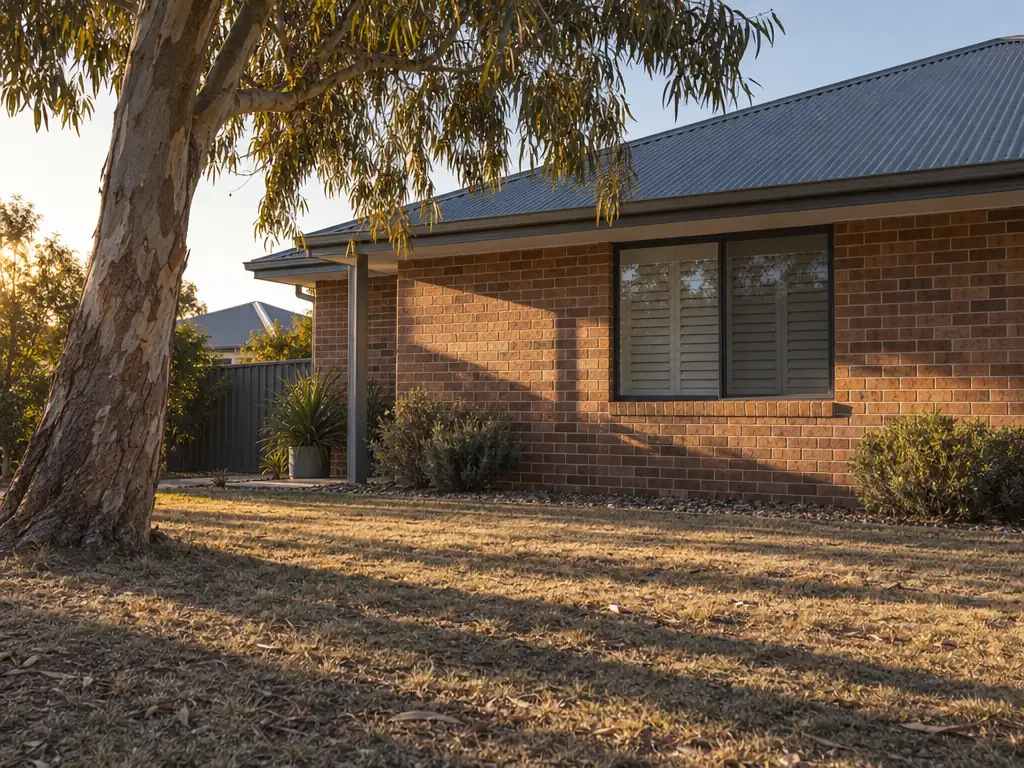
It helps to be straight about inside versus outside. External shading blocks the sun's energy before it passes through the glass. For east and west walls, Your Home names adjustable vertical shading such as external blinds as the optimum. Curtains, blinds and plantation shutters on the inside catch the sun after it has come through the glass. That is why timing is everything with them: close them before the sun lands on the window, not after the room has already warmed. With plantation shutters, closing the louvres flat on the sunny side and leaving the shaded side tilted open keeps some daylight in the house. There is currently no NSW or Australian Government rebate for external shading (checked November 2026).
One trap: a well-insulated house that has let the sun in all day holds that heat. Your Home warns that insulation without summer shading can trap built-up heat inside, an "oven" effect. With the power off, that heat has nowhere to go until evening.
Day mode
- East windows closed and shaded from early morning
- West windows closed and shaded before the sun comes round
- Spend the day in the coolest room, on the southern side
Night mode
- Windows on opposite sides open, so the air runs straight through
- Open only where security allows
- Unprotected glass is often the greatest source of heat entering a home
- close by day, open at night
- cross-ventilate without compromising security
Sources: Your Home, Shading, NSW Government, Power outages, NSW Government, Prepare your household, Ausgrid, Heatwaves
Do fans help when the power is out?
Not during the outage, because they need power too. They earn their place either side of it.
While the power is on, fans cost about 2 cents an hour to run (checked November 2026) and can make a room feel about 3 °C cooler. NSW asks households to use fans before air-con and set air-con to 24 to 26 °C, which matters most in the 3 pm to 8 pm peak. A fan only moves the air that is already in the room, so it works far better in a house that has been kept shaded.
Without power, NSW suggests a damp towel on the neck. On any hot day, cook outside or in the evening to avoid adding oven heat. And the NSW energy page is clear that if you cannot safely reduce your energy use to stay cool, don't attempt to. Safety comes first.
Which room should you move to when the house heats up?
Move to the coolest part of the home, downstairs or the southern side. In most single-storey Hunter homes, that means a south-side bedroom or living area. Our east and south facing rooms guide explains why those rooms behave differently.
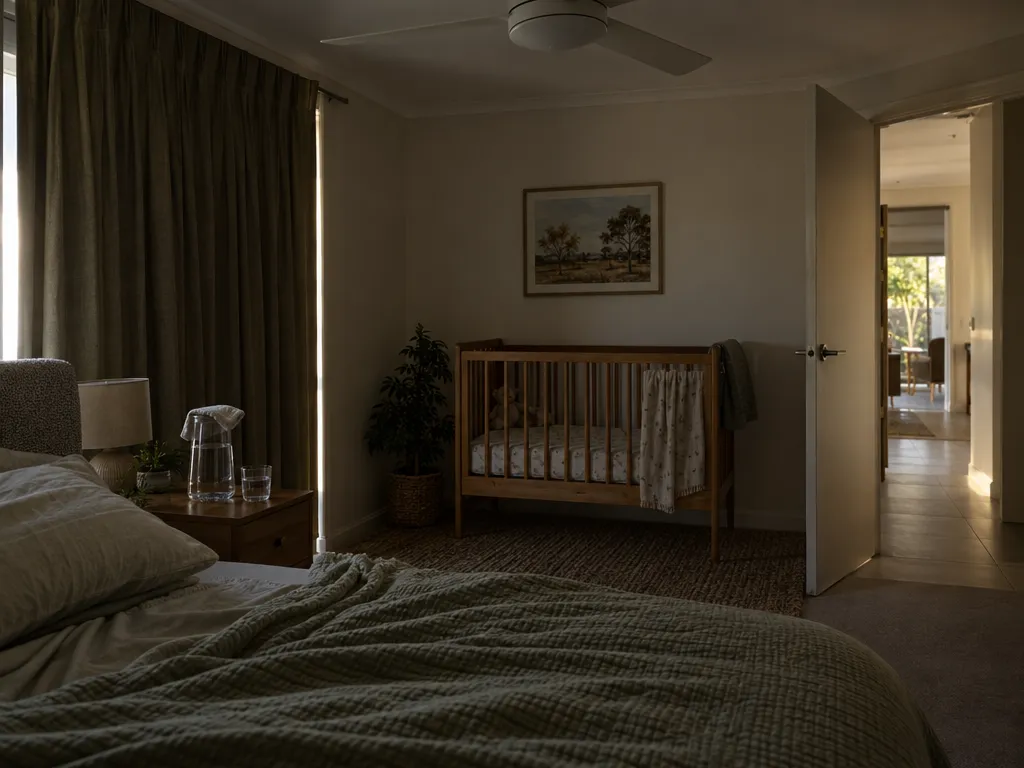
For children, NSW advises using the coolest room for a child's sleep, closing the curtains but keeping air circulating, and keeping children inside between 11 am and 5 pm.
Some people are most at risk in heat:
- older people
- babies and young children
- pregnant or breastfeeding women
- people with poor mobility
- people who are socially isolated
- people with chronic illness or on certain medications
Medicines need care too, because most medications need to be stored below 25 °C.
This is where shading reaches its limit. It doesn't replace medical advice, and it can't hold a house cool forever. If the home is too hot, go somewhere cooler such as a public pool, library or shopping centre.
When should you open the house up again?
Once the outside air is cooler than the air inside, usually after dark, open them at night. Ausgrid's tip is cross-ventilation by opening doors and windows on opposite sides, so the breeze has a path straight through.
There is a catch worth weighing. NSW says to check you can cross-ventilate without compromising security. If an open window at 2 am doesn't sit right with you, choose openings you're comfortable with rather than skipping the night air altogether.
With warm nights much more likely this summer, some nights will give you less to work with. Open up anyway when it is cooler outside, then close up again before the morning sun reaches the east glass.
While you wait for the power, leave one light switched on so you know when power returns.
How long will the fridge and freezer keep food cold?
A closed fridge keeps food cold for up to 4 hours and a closed freezer for up to 24 hours. By our working, that means the freezer holds about six times as long as the fridge (24 hours divided by 4), as long as both doors stay shut.
Frozen water bottles, which Ausgrid suggests you freeze before a heatwave, and ice and a cooler box give you somewhere to put the things you'll need, so the fridge door stays closed.
When did the power go out?
Typical answer: the power goes out at 3:30 pm
Fridge, door kept closed: cold for up to 7:30 pm the same evening
Freezer, door kept closed: cold for up to 3:30 pm the next day
Both times assume the doors stay shut.
Source: NSW Government, Power outages
Will a planned power outage still go ahead on a 40 degree day?
Usually not, but don't count on it. Ausgrid says planned outages are reviewed the day before a forecast heatwave. Where 40 degrees is forecast, planned maintenance is usually cancelled unless customers agree to proceed.
Worked example: a planned outage on a 40 degree day
You have a notice for planned maintenance on Thursday. On Wednesday, Thursday's forecast is 40 degrees.
- Step 1Ausgrid reviews planned outages the day before a forecast heatwave.
- Step 2Where 40 degrees is forecast, planned maintenance is usually cancelled, unless customers agree to proceed.
- Step 3Likely cancelled, not certain. Get the house closed up and the kit ready anyway, and check with Ausgrid.
Source: Ausgrid, Heatwaves
Your heatwave outage kit: what to have ready
Most of this takes ten minutes on a mild day and is close to impossible during a hot one with no power.
Your heatwave outage kit
- Freeze water bottles, charge phones and power banks.
- Know how to operate electric garage doors, gates and water pumps manually.
- Pack an emergency kit with medication, torches and a portable radio.
- Keep ice and a cooler box ready for an outage.
- Keep a week's food, water and medicines, and check that fridges, fans and air conditioners work.
- Save Ausgrid's 13 13 88 in your phone.
- Work out your nearest cool place now, whether that's a pool, a library or a shopping centre.
- Think about who nearby you'd check on, starting with the people most at risk in heat.
Staying safe while the power is off
Report outages and hazards: Ausgrid 13 13 88, 24/7
The NSW Government's outage safety points are short, and worth following to the letter:
- Stay at least 8 m from fallen powerlines.
- Never connect a portable generator to the home's wiring.
- Leave one light switched on so you know when power returns.
- Unplug electronics to protect them from surges.
Report fallen lines and other hazards to Ausgrid on 13 13 88.
Find your sunniest windows before the next hot spell
You can do this on any warm afternoon this week, before an outage forces the question:
- Walk the house around 3 pm and note every window with sun on the glass.
- Walk it again first thing in the morning for the east side.
- For each sunny window, ask one question: what can I close over it before the sun gets there?
Our Shutter Aspect Planner helps you sort those windows by the way they face. If the answer for your west or east glass is "nothing much", talk to Cessnock Shutters about what would suit those windows. You can get in touch through our contact page.