
Hidden-tilt shutters for new builds around Cessnock
The newer streets at Bellbird, Nulkaba and out along the Kurri Kurri corridor were built around glass: full-height windows, sliding stackers, west-facing living walls. Hidden-tilt shutters manage all that light without cluttering the view that sold you the block.
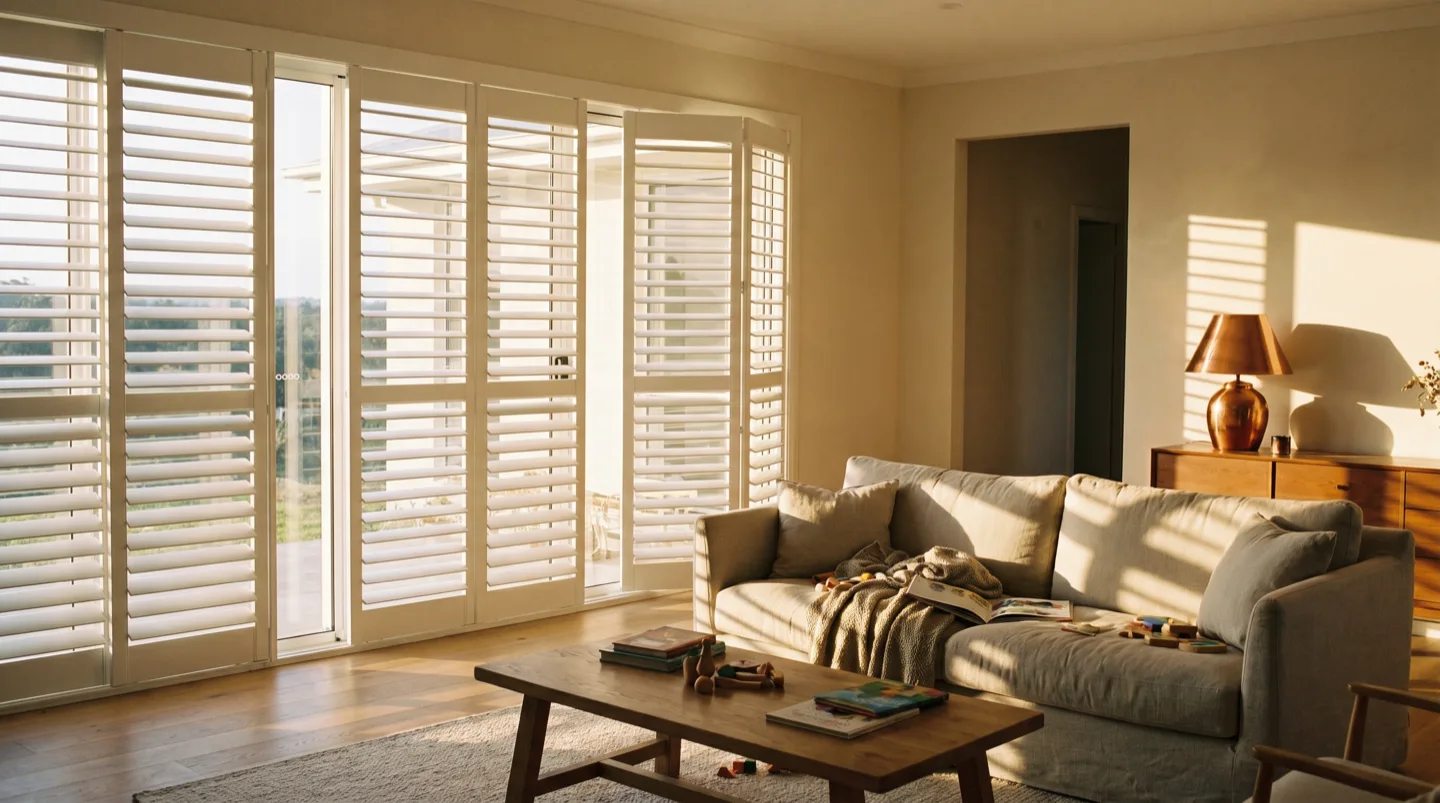
What hidden tilt actually is
The tilt gear moves off the face of the blades and into the stile, the panel's vertical edge. Nudge any blade and the whole panel follows. No rod crosses the view, so the shutter reads as a set of clean horizontal lines, which is exactly what a modern room's joinery already speaks.
It comes into its own on wide panels. A 114 mm blade spanning a big pane with nothing across it holds most of your view when open, and when the western sun gets low, the same tilt-up move that works on a cottage sash works here, just across more glass.
Big west glass on a small block
The estates growing around Cessnock and the Cliftleigh corridor put generous glass on compact lots, and there is not always a tree or an eave where the plan needed one. The result shows up in the first summer: a living wall that pours heat from mid-afternoon, and kids' rooms on the west side still warm at bedtime. Cessnock's dry inland summers push 28 degrees and past it, and the low five o'clock sun is the worst of it, coming in almost level, under eaves and straight through vertical glass.
Shutters answer that low angle better than most window furniture because the blades meet it edge-on. Tilted up, they send the light to the ceiling: the room stays bright, the glare and the direct heat stay out. Come evening you swing the panels open and let the block breathe.
- 89 or 114 mm blades keep the view generous and the lines few
- Hidden tilt keeps the face clean on floor-to-ceiling glass
- Panel splits made to your openings, hinged, bi-fold or sliding where the glass is a door, not a window
Where the opening is a stacker door rather than a window, the answer is usually bi-fold or sliding panels in the same style, so the whole wall still opens when you want it gone.
The view sold you the block. The shutter's job is to manage the light without giving the view back.
Questions we hear about hidden tilt
Is hidden tilt less sturdy than a rod?
No. The gear sits protected inside the stile rather than out on the blade faces. It is the same made-to-measure panel, with the mechanism moved, not removed.
Does it suit an older home?
It can, especially in a renovated open-plan rear extension behind a period frontage. Plenty of homes here are exactly that mix, and plenty of our jobs run front-tilt at the front and hidden tilt out the back. The honest cases for each are in the tilt guide.
Which blade width for full-height glass?
Usually 114 mm, sometimes 89 mm where panes are narrower. The trade-offs are in the blade width guide, and the final call is easiest standing in the room, at the measure, with samples in hand.
Which way does yours face?
Tell us the rooms that struggle, and when they struggle. We'll come out, stand in each one at the window, measure properly, and quote the shutters that suit the light your house actually gets. The measure and the quote cost nothing.