
Choose the shutter by how your door moves and where the panels can go when they are open. Bifold shutters fold up like a concertina and stack beside the opening, so they suit a doorway with clear wall at the side. Sliding shutters, usually called bypass shutters, run on a track and slide behind one another across the glass, so they suit a sliding glass door with no spare wall beside it.
Then check which way the glass faces. A west or east door is where a shutter earns its keep, and the layout you choose decides how easily you can close it at 4pm and open it again at night.
That is the view we take at Cessnock Shutters. The rest of this guide works through it: the doorway, the stack, the track, the sun, and what to measure before anyone quotes.
Bifold vs sliding shutters: how each one moves
A bifold shutter is a set of louvred panels hinged together in pairs. Open it and the panels fold back on themselves, usually guided along a track, and gather into a stack at one or both sides of the opening.
A sliding, or bypass, shutter gives each panel its own lane on a track. Open it and the panels slide past each other, so when they are open they sit layered over one part of the glass.
Neither is better in the abstract. One clears more of the opening, the other needs no wall beside the door. Your doorway usually makes the choice for you.
How much of the doorway you get back
Door manufacturer's claim about doors, not shutters.
Source: Vue Windows
Door makers weigh the same trade-off for the doors themselves. One uPVC door supplier says a bifold door can give up to 90% clear opening when fully stacked, against roughly 50% for a standard two-panel slider. Those figures describe doors, not shutters, but the logic carries across.
On a 3 metre opening, that works out to about 2.7 metres clear for a fully stacked bifold door against about 1.5 metres for a two-panel slider. That is our estimate, working from the supplier's figures: 3 × 0.9 and 3 × 0.5.
Shutters follow the same pattern. Bypass shutter panels always sit over some of the glass when they are open, because they have nowhere else to go. Bifold shutters can clear more of the view, but only if there is wall to fold them against.
Where the panels stack, and the wall space you need beside the door
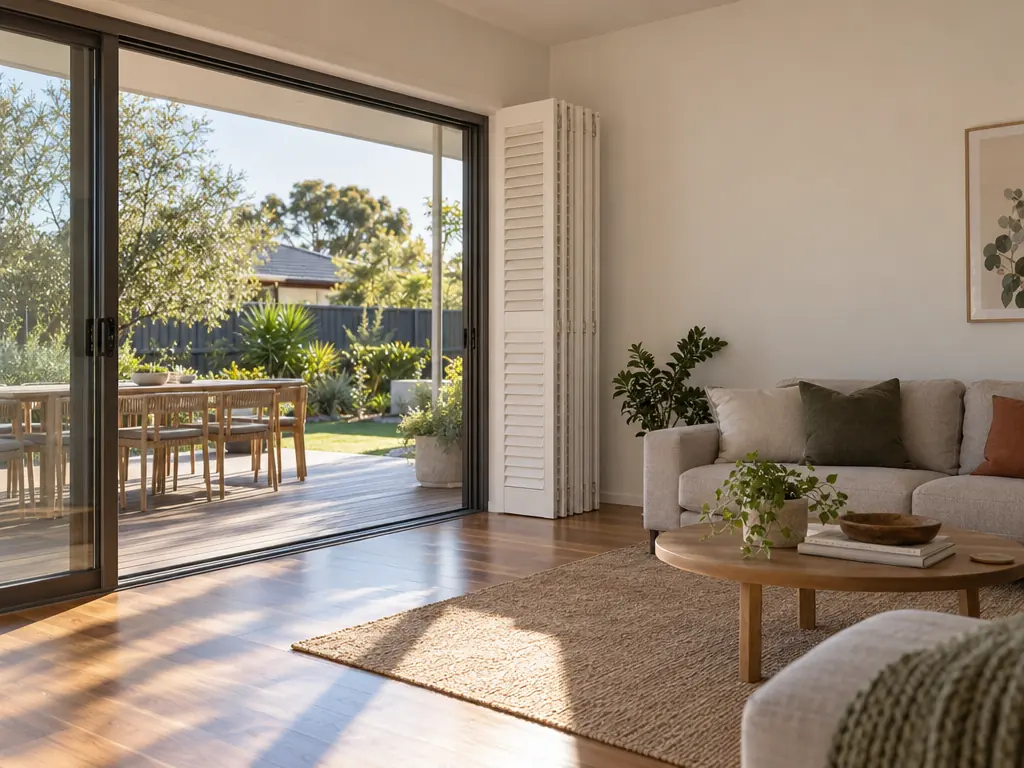
Folding doors need room for their stack. The same supplier puts a bifold stack at 30 to 60 cm deep, while sliders need no stack.
Bifold shutters bring the same question inside. Before you settle on them, stand at the door and look at the wall beside it. A light switch, a power point, a fridge or a couch in that spot will fight a stack of panels every day.
Check the floor too. A raised threshold, a thick rug or a step down to the deck all change how panels on a bottom track or a top-hung system will sit. For more on how panels split and hinge across a wide opening, our guide to panels, posts and split rods goes through the parts.
Shutters for sliding glass doors: bypass tracks and upkeep
| Bifold shutters | Sliding (bypass) shutters | |
|---|---|---|
| How it moves | Folds on hinges and stacks | Slides past other panels on parallel tracks |
| Where it sits when open | Beside the opening | Over part of the glass |
| Needs wall beside the door | Yes | No |
| Suits | Doorways with side wall, folding or wide openings | Sliding glass doors, tight side walls |
| Upkeep | Hinges and moving parts, as door makers advise lubricating bifold doors | Keep the track clear of debris, as door makers advise for slider tracks |
Source for upkeep: Vue Windows
For a sliding glass door, a bypass shutter is the natural match. The shutter slides the same way the door does, so you can open both without the panels swinging into the room.
Think about traffic. If this is the door the kids and the dog use forty times a day, the shutter has to open as quickly as the door does. Sliding a panel across with one hand is quicker than folding a set back. On a door you open mostly on weekends, a bifold that clears the whole view may be worth the extra fold.
Upkeep follows the mechanism. For doors, bifolds have more hinges and moving parts and benefit from periodic lubrication, while slider tracks should be kept clear of debris. Shutters are much the same: hinges on a bifold, a track to keep clear on a bypass set. Our cleaning guide covers the routine.
See the bi-fold and sliding shutter panels page for the range side of this choice.
Shutters for patio doors facing west or east
Picking a shutter style on looks alone misses its main job. The NSW Government says external shading such as shutters blocks the sun's energy before it passes through the glass, and names west-facing windows with intense direct sun as the best fit.
A glass door is a lot of glass. YourHome, the Australian Government's housing guide, says up to 87% of a home's heat gained comes through windows. It also says effective shading can block up to 90% of the heat from direct sun, with shading such as eaves, awnings and external blinds.
West is the hard one. On a summer afternoon, a west-facing window can have an angle of incidence from near 0° to 30°, which means the sun hits it almost straight on and heat gain is close to its maximum. Cessnock Airport's weather station recorded 36.8 °C on 12 October, before summer had even started.
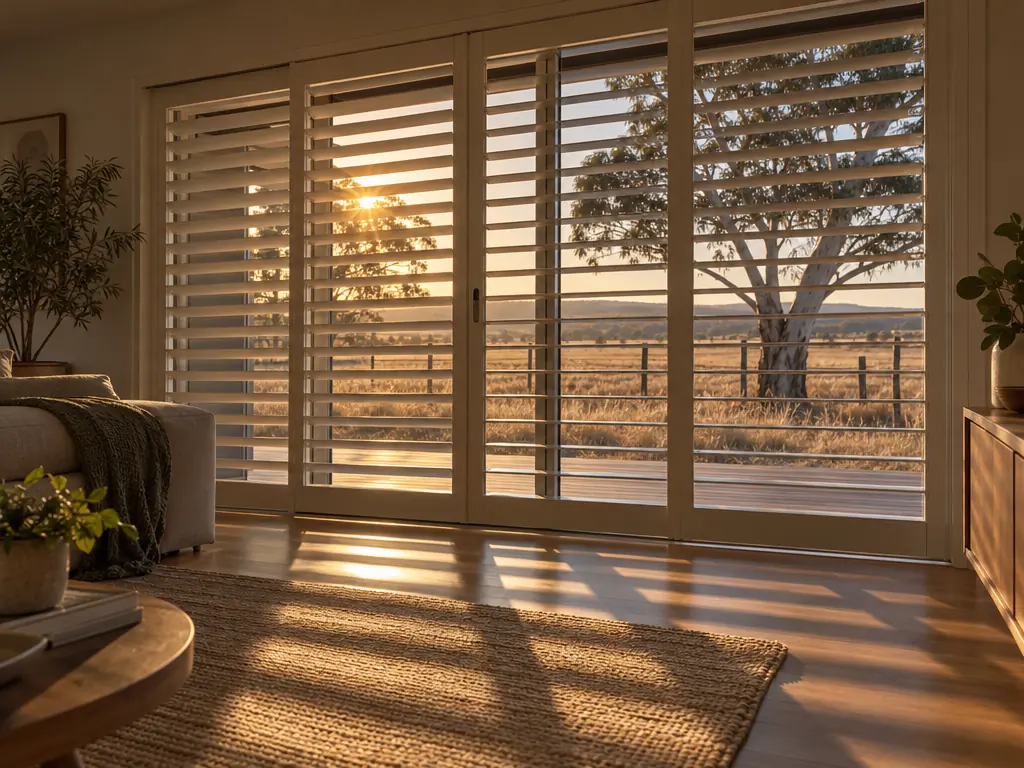
YourHome's answer for these sides of the house: on east and west façades, adjustable vertical shading is the optimum solution, because low morning and afternoon sun is harder to shade. YourHome's example is external blinds, outside the glass.
Most plantation shutters sit inside the glass. YourHome counts window furnishings such as louvres, blinds and curtains among the things that can improve a window's thermal performance, especially on existing windows. Shading also does quieter work: the NSW Government lists reducing glare and protecting furniture and floors from UV fading among its reasons.
If you are not sure which way your door faces, the Shutter Aspect Planner helps. Our earlier pieces on west-facing room heat and daylight saving and hot west windows explain why that side works so hard in summer.
When to close the shutters and when to open them
A shutter only helps when it is in the right position, so pick a layout you will actually move.
In summer, the NSW Government advises using shades during the hottest parts of sunny days, and to close doors, windows, blinds and curtains during the day to keep heat out. At night, open windows for the cool breeze. A fan is very little to run and can make a room feel about 3°C cooler.
In winter, flip it. Keep shades open or retracted to take in free solar heat on sunny days, then close up at night, because up to 40% of heating can be lost through windows.
That is two movements a day on the door you use most. If folding a bifold set back feels like a chore, you will leave it open, and a bypass shutter may serve you better.
What to measure before a quote visit
Source for item 7: Vue Windows
The door matters more than its name. The door supplier notes that seal quality, glazing and hardware matter more to thermal performance than door type, which is a good reason to look at the actual opening before choosing a layout.
Before anyone quotes, have these ready:
- Opening width. Wall to wall, not just the glass.
- Wall beside the door. How much clear wall sits on each side, and what is on it.
- How the door moves. Slider, bifold or hinged, and where its own track sits.
- The floor. Threshold height, rugs, and any step down to the deck.
- Traffic. Main thoroughfare, or an occasional door.
- Aspect. Which way the glass faces.
- Door condition. Seals and hardware that need attention first.
For external shading, the NSW Government says larger, heavier items such as shutters should be professionally installed so they are mounted safely and securely.
Before you sign a quote
There is currently no NSW or Australian Government rebate for external shading, so budget on the full price.
If a job counts as residential building work in NSW, a written contract is required once the contract price passes a set amount, and the maximum deposit is 10%. Whether a given shutter job falls under those rules depends on the work, so ask the question and get the answer in writing.
The figures worth keeping
- Bifold door clear opening: up to 90% (manufacturer claim, doors)Vue Windows
- Two-panel slider clear opening: roughly 50% (manufacturer claim, doors)Vue Windows
- Heat gained through windows: up to 87%Your Home
- Heat blocked by effective external shading: up to 90%Your Home
- Heating energy lost through windows: up to 40%Your Home
- NSW written contract: required above a set contract price (NSW Government)
- NSW maximum deposit: 10% of contract priceNSW Government
Source: Vue Windows, Your Home, NSW Government
Door clear opening, window heat gain and loss, what shading can block and the NSW contract basics, each with its source, side by side.
Book a measure for your doorway
Measure the opening and the wall beside it, note which way the glass faces, and think honestly about how often the door gets used. With those answers, the bifold or bypass question usually settles itself.
When you are ready, book a measure and quote with Cessnock Shutters and we will look at the doorway with you.